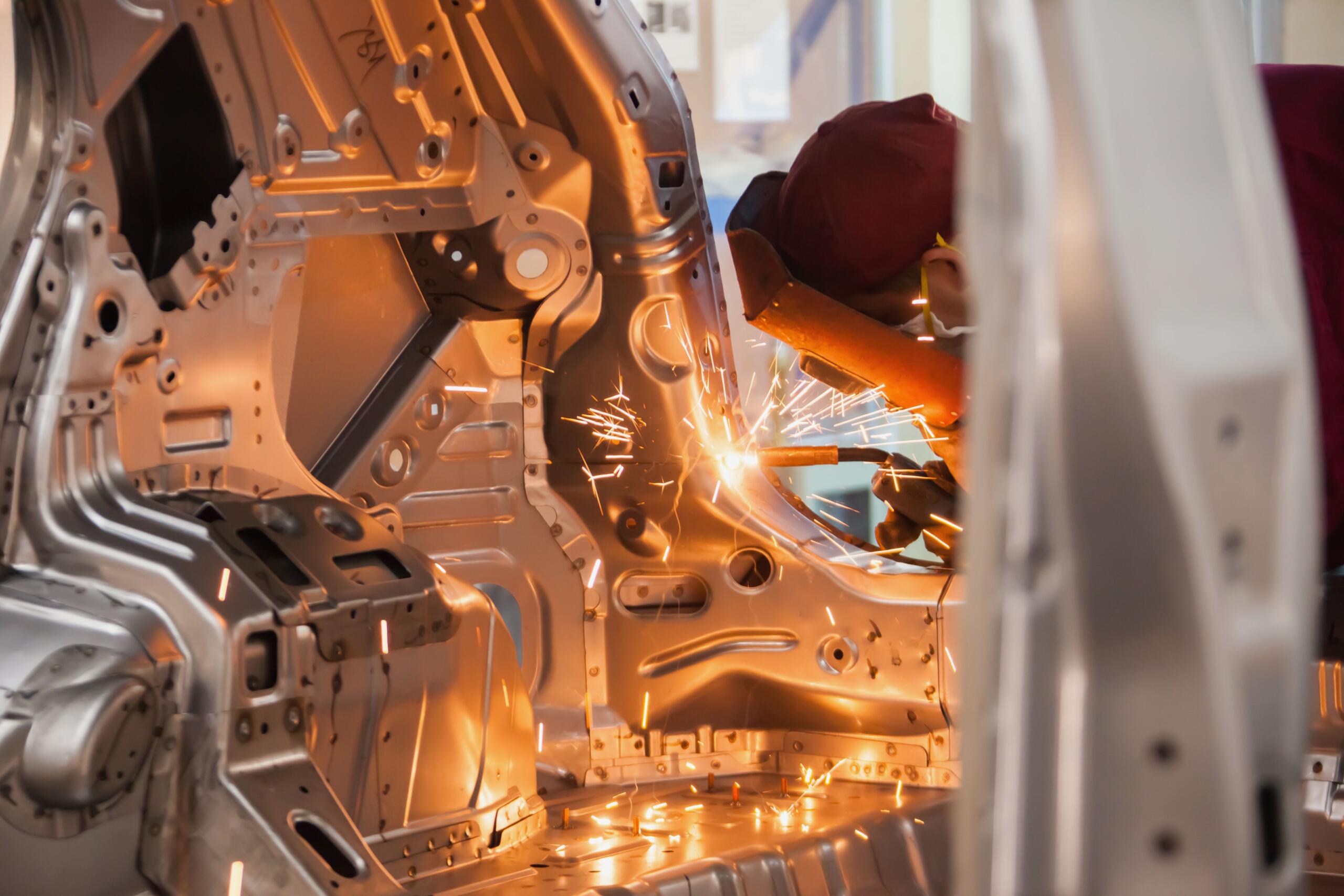
Jonesboro, AR – JonesboroRightNow.com – As large companies flock to Northeast Arkansas, area schools are ensuring students can take on new jobs to help keep the industry healthy and local.
In May, Jonesboro Right Now (JRN) explored the scale of the industrial boom transforming the region, highlighting massive investments—including the upcoming $1.9 billion U.S. Steel facility in Osceola—that are turning the region into the nation’s premier steelmaking capital.
| READ MORE: The Billion-Dollar Ripple: How an Industrial Boom is Reshaping Northeast Arkansas
But as billions of dollars are being invested, regional leaders are actively confronting a more complex challenge: Building the “human infrastructure” required to run it.
With thousands of high-tech manufacturing jobs flooding into the Delta, a multi-tiered educational pipeline has mobilized to ensure that the wealth generated by this economic surge stays in the pockets of local families rather than in the pockets of out-of-state workers.
| ADD US ON GOOGLE NEWS: Click here to see more local news from Jonesboro Right Now
In a follow-up to May’s coverage, JRN spoke to multiple schools about how Northeast Arkansas is retooling to grow its own industrial workforce.
The Shop Floor Pipeline
Prepping Northeast Arkansas for an industrial boom doesn’t start at the factories—it starts on the high school shop floor.
At the Northeast Arkansas Career and Technical Center (NEACTC), that preparation looks like a brand-new Haas UMC-500 5-axis CNC machining center paired with an automated cobot.
For Garrett Barnes, currently NEACTC’s assistant director and soon-to-be director, the acquisition isn’t just a flashy upgrade; it is a direct response to an evolving industrial landscape.
“It brings the technology that they have in their facilities into a classroom setting to cut down on that lead time for training that they have,” Barnes said, noting that high-precision automation is already the baseline for modern manufacturing and defense contractors operating across the state.
By embedding these multi-axis systems into high school classrooms, Barnes said instructors like Chase Smith are already preparing industrial technology students to compete on a national stage through advanced mechatronics skills competitions.
Mechatronics is a field of engineering that combines mechanical, electrical, computer, and control systems. The specialty is typically used in robotics and automated manufacturing.
While billions in industrial investments flood the region, there’s a debate over whether these highly technical, high-paying roles will be filled by local or out-of-state families. Barnes argues that high-tech secondary training is the ultimate shield against this problem.
| READ MORE: Jonesboro Unlimited Awarded $3M for Industrial Site Development
“If they’re willing to move across the country for this opportunity, they would also be willing to move across the country for another opportunity, too,” Barnes explained. “If we can just continue to grow the existing roots that we have here with our students and local talent, I think that’s going to hold much stronger for the future … It’s a positive domino effect.”
The Two-Year Engine
If secondary centers lay the local groundwork, one of the regional engines translating that interest into six-figure careers is Arkansas Northeastern College (ANC) in Blytheville.
Long recognized as “The Steel College of Arkansas,” ANC has been forced by the scale of the current industrial expansion to broaden its recruitment lens beyond Mississippi County lines.
Stacey Walker, ANC’s associate vice president for workforce development, said to keep pace with the localized boom, the institution is pulling talent from neighboring hubs like Craighead County, and even drawing applicants from as far as Missouri and Tennessee.
“It’s twofold,” Walker explained. “We’re training our local workforce to pick up where needed … we want to set the groundwork for entry-level individuals to come in.”
A critical piece of that transition involves slashing the corporate learning curve.
Mirroring concerns raised by regional high school technical centers, ANC’s 90,000-square-foot facility houses its secondary tech center, college-credit tracks, and customized corporate training divisions under a single roof. High school juniors and seniors are brought in daily to take the exact same high-tech robotics and basic electricity classes as traditional college students, earning college credit before they ever receive a diploma.
According to Walker, the secret to their success is a “reverse” approach to curriculum development.
“It works backward because we do a lot of customized training for these industries,” Walker said. “What I hear from the industries, I make sure that our instructors make tweaks to the degree plans … it tells me what I need to feed into the curriculum to make sure they’re relevant for employment.”
To meet industry needs, ANC relies on an 80-hour “Steelmaking Boot Camp” that condenses industry training into a two-week track for immediate workforce re-entry, yielding an 80% direct employment rate.
For students moving along traditional academic lines, the capacity is equally vast.
Walker said ANC’s career placement division supports between 300 and 400 career and technical students per semester, maintaining a 98% conversion rate from corporate student intern to full-time industrial employee across 19 regional manufacturing partners.
The Intellectual Apex
At the top of this regional talent architecture sits the higher education research engine, transforming Northeast Arkansas from an industrial manufacturing site into a top-tier national hub for steel research
At Arkansas State University’s College of Engineering and Computer Science, that transformation is driven by a massive, multi-tiered federal investment.
In February, Congress approved $2.1 million in appropriations to support the acquisition of industry-grade testing equipment for the university’s Center for Advanced Materials and Steel Manufacturing (CAMSM).
| READ MORE: Congress approves $2.1 million in appropriations to A-State to support steel research and testing
Outgoing Dean Abhijit Bhattacharyya noted that this funding must be viewed as part of an expansive, long-term $10 million structural blueprint to permanently establish the research center.
“There are very few of these around the country,” Bhattacharyya stated, highlighting that CAMSM maps to the region’s trajectory as it rapidly becomes the dominant steel-producing corridor in the United States.
On the laboratory floor, that capital translates into cutting-edge computational resources.
Dr. Drew Fleming, the principal investigator for the $2.1 million grant, explained that the center utilizes artificial intelligence and machine learning to map hidden relationships in steel chemistry and processing variables. By deploying thermodynamic software and high-throughput validation gear, researchers can simulate actual mill conditions digitally, avoiding the need to interrupt production schedules on localized mill lines.
“It’s not very academic,” Fleming explained, referring to their secondary Certificate in Materials Manufacturing, which saw enrollment surge to over 30 students this year. “It’s more hands-on and industry-focused … giving students real experience with testing techniques, including ISO and ASTM standards that they would actually use in the industry.”
To ensure local families can claim these advanced engineering roles, A-State has engineered highly flexible, stackable pathways in partnership with regional technical colleges such as ANC and ASU-Newport. Through institutional partnerships, students can fast-track into industry roles with a two-year associate degree, then complete the remaining 60 credits toward a full bachelor’s degree through a flexible, employer-subsidized online manufacturing track.
For incoming Interim Dean Dr. Yeonsang Hwang, who takes the helm on July 1, sustaining this momentum is vital for regional equity, though he emphasized that the center’s launch is a collaborative effort. Key researchers like Dr. Mohammadreza Daroonparvar, assistant professor of materials engineering, and Dr. Rajesh Sharma, director of engineering technology, serve as critical pillars behind the grant writing and foundational research that brought the master plan to life.
“This is a good model toward the future, connecting manufacturing education, training, and entire community development altogether,” Hwang said.
Ultimately, the synchronized efforts across NEACTC, ANC, and A-State represent something far larger than traditional workforce placement—they represent a total redefinition of the Delta’s role in the global economy.
As Dean Bhattacharyya prepares to step down later this month, he views this human infrastructure as an economic legacy that will echo far beyond the borders of Craighead and Mississippi counties.
“This funding is both funding now as a gift from the nation to this region to the Delta, and so as to the university,” Bhattacharyya reflected. “And when the center is up and running with data science and AI being a strategic part of the center operations, it’ll be the university and the Delta’s gift back to the nation.”
| DAILY BRIEF: Sign up for the Jonesboro Right Now Daily Brief Newsletter